
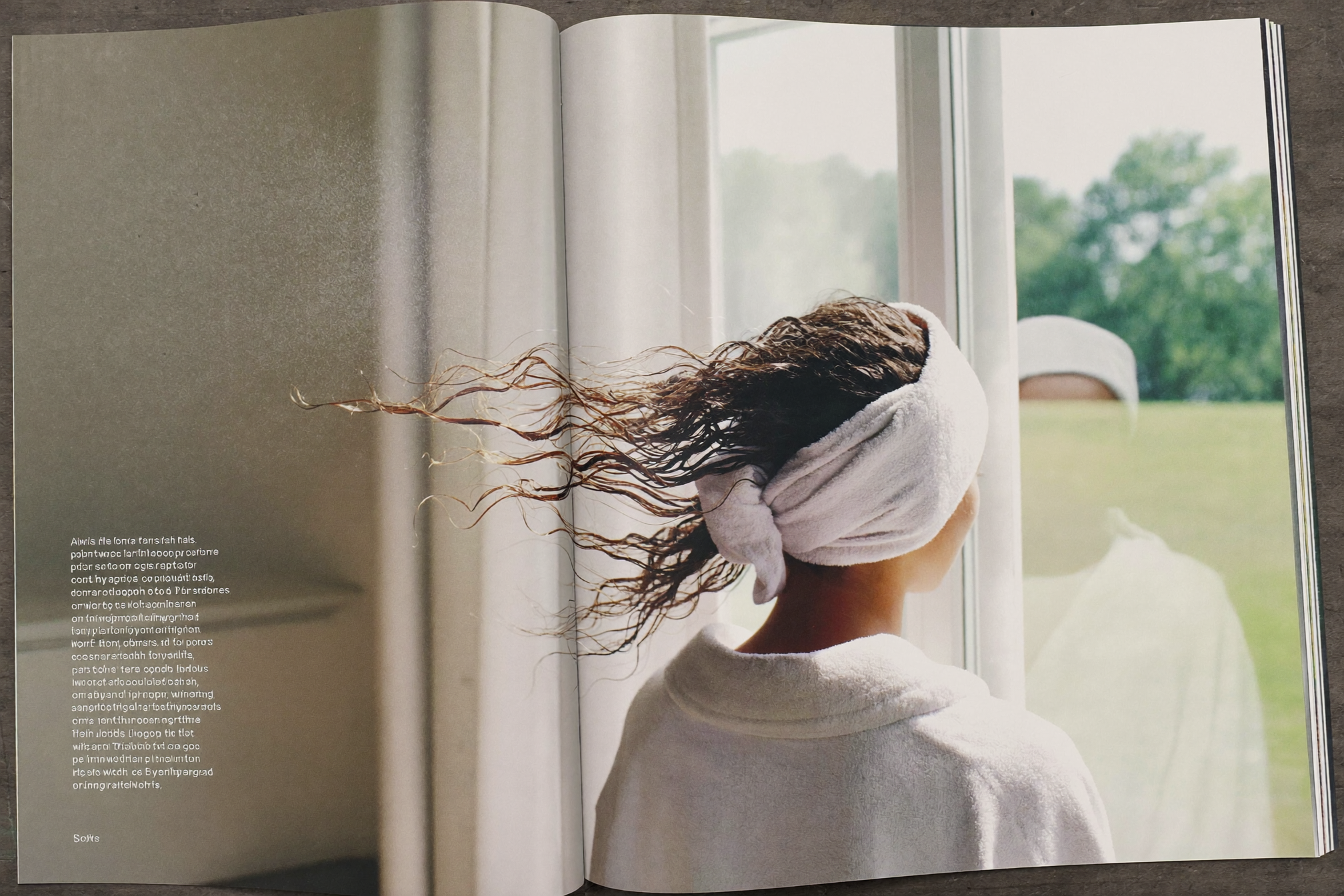
Air-drying should be the easiest thing in beauty — do nothing, get hair. Yet ‘I just let it dry naturally’ produces silk on one woman and static on another, and the difference is thirty seconds of technique at the wet stage. Heat-free is only effortless-looking. The effort just moved earlier.
The towel is where it goes wrong first
Terrycloth rubbing roughs the cuticle while it’s at its most fragile, and frizz is decided in that moment — hours before it appears. Swap to a microfibre towel or a cotton T-shirt and blot, squeeze, wrap. Never wring, never turban-twist tightly at the hairline. This single swap does more for air-dried hair than any product below.
Product goes on soaking, not damp
The counterintuitive one: leave-in and creams distribute best on very wet hair — apply at 90% wet, scrunch or smooth, then stop touching. By the time hair is merely damp, product sits on top instead of absorbing evenly, and every later touch converts smoothness into frizz. Air-drying is a no-fiddling discipline. Hands are the enemy from minute five onward.
By hair type, briefly
Straight and fine: a light mousse at the roots, combed through once, then part it where you want it and leave it — fine hair sets fast and remembers everything. Wavy: a curl cream scrunched in, then a loose braid or two for pattern insurance. Curly: leave-in plus gel, scrunched, then the crunchy cast broken with dry hands hours later — the cast is the technique, not a mistake. Coily: leave-in on soaking hair in sections, twisted or braided while wet, unravelled only when fully dry.
The finishing window
Fully dry — really fully, not almost — is when you can touch again: break casts, shake roots, smooth a drop of light oil over the surface. Patience until that point is the whole method. Air-drying doesn’t take more skill than heat styling. It takes more restraint, which might be harder.
The hybrid method for cold months and busy mornings
Pure air-drying meets its limits in winter and before 9 a.m. meetings, and the hybrid approach keeps the damage math honest. Air-dry to eighty percent — the towel-and-wait portion of the routine unchanged — then finish with a diffuser on medium heat for the final stretch, scrunching upward for wave types or hover-drying for straight styles. The physics favours you: most heat damage occurs in the long middle phase of drying when water is boiling out of the cortex, so skipping straight to the final phase costs a fraction of a full blow-dry. Cold-shot the finish to close cuticles. Total exposure: three or four minutes versus twenty. On no-wash mornings, the reset version is a mist of water on the surface, thirty seconds of finger reshaping, and one drop of oil from our oiling guide — yesterday’s air-dry, revived rather than restyled.
Frequently asked questions
Why does my air-dried hair look great everywhere except the roots?
Roots dry flat under their own weight. Flip your part to the opposite side while drying and return it when dry, or clip two roller clips at the crown for the first twenty minutes — volume without a single degree of heat.
How do I air-dry for a straight look without frizz?
A smoothing cream on soaking hair, comb once for even distribution, then anchor: tuck behind ears or use a loose low twist, and genuinely stop touching. Straight air-drying punishes fiddling hardest of all.
Is air-drying actually better for my hair?
Skipping daily heat is measurably kinder over months — less cuticle damage, better moisture retention, colour lasting longer. One caveat: hair kept soaking wet for many hours stresses the strand too, which is exactly what the eighty-percent hybrid solves.
For the clinical baseline on this, see the AAD’s everyday scalp and hair care guidance.