
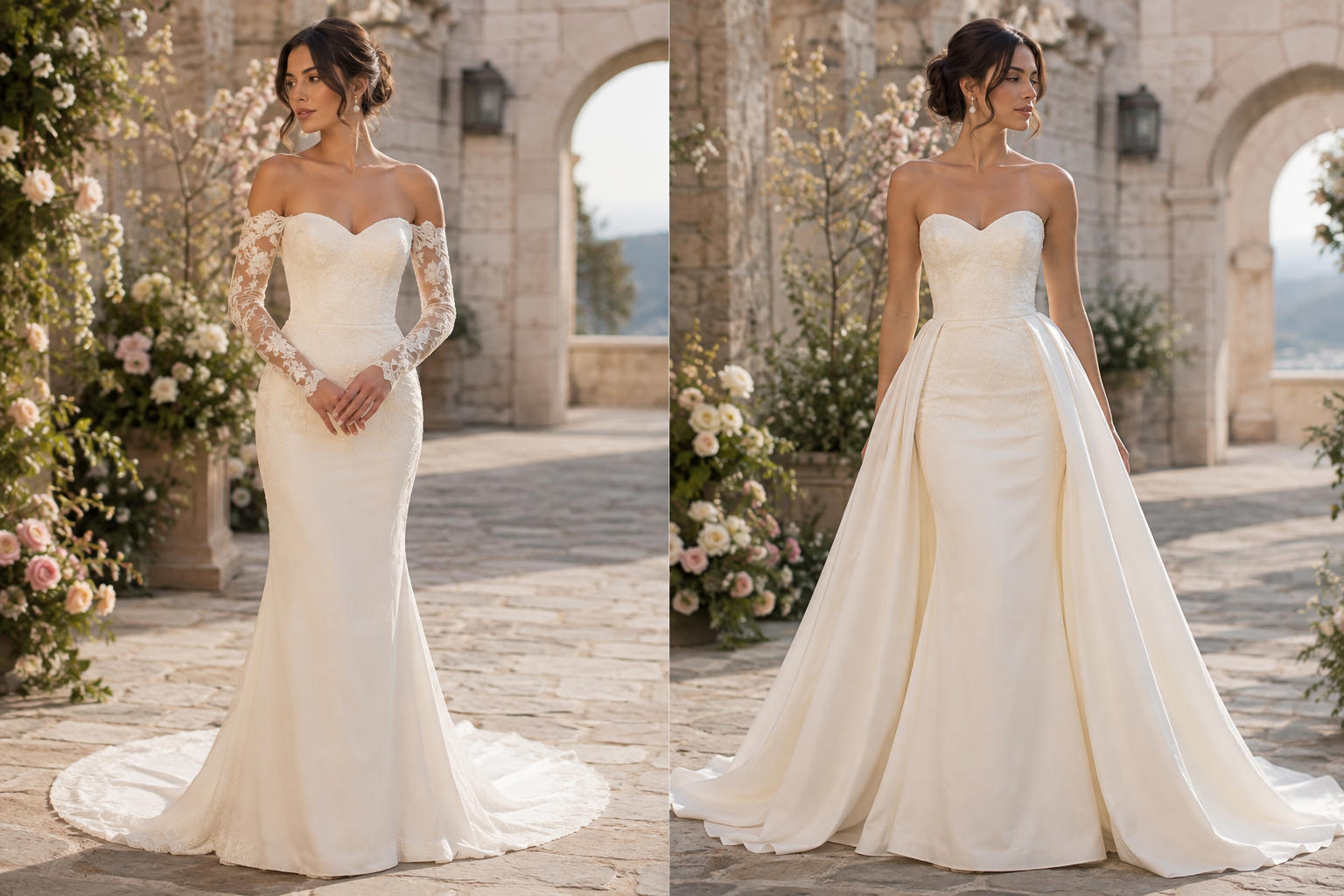
Detachable wedding dress sleeves change the framing of your upper body; an overskirt changes the volume and outline of your gown. If you want two bridal looks, start by deciding which change matters most to you: added coverage, a different silhouette, or easier movement after the ceremony.
Removable elements feature in Who What Wear’s 2026 bridal trend coverage. The useful question is how that idea works with your actual dress. This guide offers a fitting checklist and a comparison worksheet to help you decide, rather than a list of products we have personally tested.
Image note: the illustrations in this article are AI-generated fashion concepts. They do not show a specific designer gown or a product available to buy.
Detachable sleeves vs. an overskirt: which change do you want?
| Your priority | Option to explore | Check before buying |
|---|---|---|
| A different shoulder or arm detail | Detachable sleeves | Arm movement, slipping and how the sleeve meets the bodice |
| A fuller ceremony silhouette | Detachable overskirt | Waist fit, added weight, hem and attachment points |
| Less fabric for the reception | A removable layer over a base dress you already enjoy wearing | How the base dress feels and looks on its own |
| More coverage | Sleeves or a separate topper, depending on the design | Actual opacity and neckline coverage; sheer lace may not meet your needs |
| A quick, uncomplicated change | The option you can remove comfortably during a fitting | Required help, fasteners and a place to store the removed piece |
Neither option is automatically more comfortable or less expensive. A light overskirt can be easier to manage than a heavily embellished sleeve, while a simple sleeve can require less adjustment than a structured skirt. Assess the actual pieces together.
Detachable sleeves: check movement as carefully as appearance
Sleeves can bring a romantic lace detail to a plain gown or change a strapless look without adding skirt volume. Some designs connect to the dress; others sit independently on the arms. Ask the boutique to explain the construction of the exact style you are considering.
At the fitting, raise your arms, reach forward and gently bend your elbows. Notice pulling at the upper arm, scratchy seams and movement at the top edge. If a sleeve slips while you stand still, ask whether an alteration can address it and what that alteration will cost.
Compare the lace against your bodice in daylight. Two fabrics described as ivory may have different undertones. A deliberate contrast can be beautiful, but it should feel intentional. Photograph the full outfit as well as the join between the sleeve and gown.
If coverage is the reason for buying sleeves, check the outfit from the front, sides and back. An off-the-shoulder sleeve leaves the shoulders exposed, and a sheer fabric may offer very little visual coverage. Explain your requirements clearly before ordering.
An overskirt: love the base dress before adding the drama
An overskirt is an additional skirt layer worn over the gown. It can create a fuller outline or add a train, depending on its cut. Take it off during the appointment and spend time in the base dress: that is the outfit you will wear once the extra layer is removed.
Ask how the waistband and fasteners sit against the gown. Check for bunching, a visible ridge or pulling at the attachment points. Sit down, walk, turn and try a few careful steps with the consultant’s guidance. Bring shoes of a similar height to those you plan to wear.
Consider the whole outfit from behind. An overskirt, gown train and veil may overlap in ways that look different in a photograph than in the mirror. Ask how each layer will be managed after the ceremony, including whether the base dress still needs bustling.
Compare the complete cost, not just the accessory price
Request separate written estimates for the dress, removable piece, attachment work, alterations and any applicable delivery or rush fees. Buying a separate accessory does not establish that it can be fitted to your gown.
Use this calculation for each option: dress + removable piece + fitting and alteration work + applicable fees = complete outfit cost. Compare that total with a second outfit only if you actually want a second outfit. A convertible gown is a styling choice, not a guaranteed saving.
Before paying, confirm the colour, size, material, delivery estimate and return or cancellation terms. If you are still choosing the gown, use our first wedding dress appointment checklist to prepare your questions.
A fitting checklist you can copy into your notes
- Base dress: do I like the neckline, fit and movement without the removable detail?
- Appearance: do the colour, texture and proportions work together in daylight and photographs?
- Comfort: can I sit, walk, reach and turn without slipping or pulling?
- Construction: how is the piece secured, and will attachments show after removal?
- Changeover: who will help, where will we change, and where will the piece be stored?
- Timing: can the boutique complete and fit everything before the wedding?
- Cost: is the full written estimate within my outfit budget?
Practise the change at a fitting with the person who will help on the day, if possible. Make a short sequence of notes or photographs with the boutique’s permission. Allow time in your schedule for the change instead of assuming it will take seconds.
Turn an AI bridal image into a realistic brief
Use an AI image to describe the features you like: a fitted base dress, floral sleeve pattern or soft skirt volume. Do not treat the image as proof that a fastening will hold or that a fabric will move as shown. Ask your consultant which details can be achieved with available garments and which would require custom work.
For example, a useful brief is: “I like the lace at the arms and the plain skirt, but I want to raise my arms comfortably and remove the sleeves after the ceremony.” It gives the person fitting the dress something concrete to assess.
Common questions
Can detachable sleeves be added to any wedding dress?
Do not assume so. The bodice, fabric and proposed attachment all matter. Ask a bridal alterations specialist to assess the actual dress before ordering separate sleeves.
Can I wear sleeves and an overskirt together?
You can explore both, but try the complete outfit and each simpler combination. Choose the version whose weight, proportions and movement you prefer. You do not need every removable detail to create a noticeable change.
Is an overskirt the same as a bustle?
No. An overskirt is an additional layer; a bustle lifts or secures a dress’s existing train. Removing an overskirt may still leave a train on the base gown. Ask how that train will be managed.
What should I choose if I cannot decide?
Return to the change you want most. For a new shoulder or arm detail, try sleeves first. For a fuller silhouette, try an overskirt. If neither improves the outfit enough to justify its cost and handling, keep the dress you already love.
Next, consider your bridal shoes and accessories and hairstyle with or without a veil so the complete look works together.